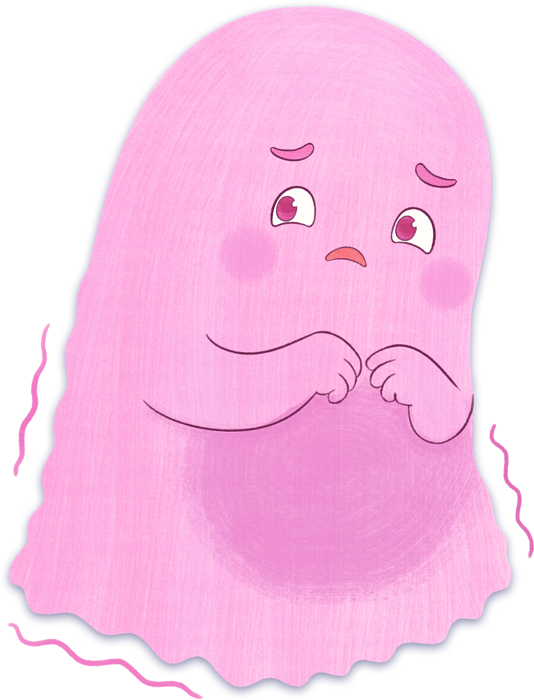

An adult may ask whether young children are angry and hear a firm denial, even when their posture or expression suggests tension. The familiar principle "name it to tame it" has a place in emotional learning. With preschoolers and children in the early school years, it helps to consider what comes before the request for a feeling word.
How Naming an Emotion Can Help
Giving an emotion a name can support the process of managing it. Brain-imaging research with adults found lower activity in the amygdala, which is involved in emotional alarm responses, and greater activity in a region involved in regulation during affect labeling. Research published in 2025 also linked children's knowledge of emotion words with adaptive regulation in a model that accounted for general language ability.
A Body Sensation Gives Naming a Starting Point
Emotions can be felt physically before they are described. Anger may involve warmth or tense muscles; fear may bring a tight chest or a flutter in the tummy; sadness may be accompanied by heaviness. The ability to notice these internal signals is called interoception, and young children are still developing it.
A question that begins with an emotion word can ask young children to identify something abstract straight away. Starting with a sensation gives them a concrete experience to consider. The Feelings Ghost Method therefore uses the sequence Feel it, Name it, Help it: begin with "What do you feel in your body?", continue with "Which feeling might that be?", and then explore support for the body together.
Three Ideas to Carry into the Conversation
- Feeling words give children more ways to respond. A wider vocabulary helps them understand and communicate their internal experiences.
- A body observation makes the first question concrete. Warm hands or a strange tummy sensation may be easier to describe than a feeling such as frustration.
- Every feeling has a place. Children may feel more able to share when adults show that all feelings can be heard.
Five Body-First Ways to Develop Feeling Words
Ask about sensations before naming
Begin with "What do you feel in your body?" Children might describe warmth in their hands or another body signal. That observation gives them something to consider when the next question is "Which feeling might that be?"
Leave room for a different feeling word
A suggestion can be offered gently: "I can see tightly closed hands. Could anger be part of what is happening?" Presenting a word as a possibility allows children to decide whether it fits.
Model words alongside body observations
Adults can describe their own experience: "I notice tension in my shoulders, and I think I am worried about getting there late." Hearing feeling words used in ordinary situations helps children learn how those words relate to experience.
Use color as another way to communicate
Books including Anna Llenas's The Color Monster have introduced many homes and classrooms to associations between colors and feelings. Color monster activities can offer a familiar way of pointing to a feeling. Feelings Ghost begins by asking about the body's experience and then exploring a color that might fit.
Extend the vocabulary as children are ready
Begin with familiar words for joy, sadness, anger, fear and calm. Gradually introduce possibilities such as proud, excited, worried or "too much" as children become ready to use them.
How Support Changes with Development
Preschoolers often benefit from brief questions, one feeling word at a time and an adult who supports the body alongside them. Children in the early school years may begin to recognize combinations of feelings, such as excitement together with some fear, and choose ways to support their bodies.
Joy and pride also deserve to be recognized and named. These comfortable feelings can be shared and enjoyed without trying to make them disappear.
A body observation gives a feeling word an experience to refer to. Allowing young children to notice that sensation first can help the naming conversation make sense.
Sources
- Lieberman, M. D., Eisenberger, N. I., Crockett, M. J., Tom, S. M., Pfeifer, J. H., & Way, B. M. (2007). Putting feelings into words: Affect labeling disrupts amygdala activity in response to affective stimuli. Psychological Science, 18(5), 421-428.
- Llenas, A. (2018). The Color Monster: A Story About Emotions. Little, Brown Books for Young Readers.
- Shipkova, M., Milojevich, H., Lindquist, K. A., & Sheridan, M. A. (2025). Children's emotion word knowledge is associated with adaptive emotion regulation: Links to family-level and child-level factors. Emotion, 25(8), 1982-1996.
- Siegel, D. J., & Payne Bryson, T. (2011). The Whole-Brain Child. Delacorte Press.