
Rugs, cushions, and a feelings chart often mark a quiet spot in a home, classroom, or therapy room. The space offers somewhere to pause when emotions grow.
Yet a thoughtfully arranged space can still go unused. A child may stay away, reach it only after a feeling has become overwhelming, or sit quietly with plenty of energy still in the body.
The setup may need a different starting point. An invitation to settle can come before a child is physically ready to slow down.
Three reasons the calm corner can miss the moment
The invitation comes when the feeling is strongest
At an emotional peak, a racing heart, tense muscles, and quick breathing can make reflection and words difficult to reach. Asking a young child to select a strategy from a chart places demands on skills that can be especially hard to use in that moment.
Stillness comes before movement
Books, cuddly toys, and glitter jars may suit a body that has begun to settle. When energy is still high, pushing, squeezing, or moving may be a more useful first step. Sitting quietly can be too much to ask just then.
The space feels like separation
A direction to use the corner during a difficult moment can feel like a punishment. Research on early self-regulation highlights co-regulation: children practice settling with support from a calm adult before managing it independently. Visiting the corner together can keep that connection available.
Why the body knows first
A child may notice a fluttery stomach, warmth in the face, clenched hands, or heaviness in the chest before finding a feeling word. Detecting signals from inside the body is called interoception, a sense that continues developing during childhood.
Research suggests a connection between awareness of these signals and emotional regulation. The familiar advice to "name it to tame it" needs a starting point for that naming. For a young child, noticing a physical clue may come before identifying the emotion.
This somatic approach gives the corner an earlier entry point. Adults can invite children to explore a body clue while a feeling is still manageable.
Arrange three zones around the body-first method
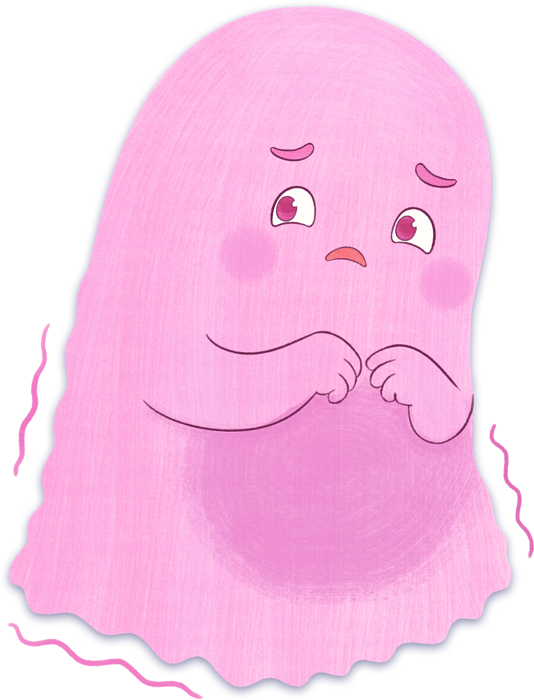
Arrange the space to follow the Feelings Ghost sequence: Feel it, Name it, Help it.
Feel it
Place a body-clue poster where a child can easily see it, then ask: "What do you feel in your body?"
An answer may take time to emerge. An adult can gently suggest noticing the stomach or hands while the child learns to recognize different sensations. A first response such as "My tummy feels funny" is enough to begin.
Name it
Display feeling colors beside the body clues and ask: "Which feeling might that be?" Leaving room for uncertainty reduces the pressure to choose a single right answer.
A chart inspired by The Color Monster can support this part of the process. The body clues provide a starting point before the feeling word.
Help it
If the feeling is uncomfortable, offer a physical action: press both palms against a wall, squeeze a cushion, hold a firm self-hug, or take slow breaths with a hand resting on the stomach. A weighted cushion or small blanket may provide comforting pressure.
Joy and pride belong here as well. Enjoy those feelings, share a celebratory jump, or celebrate an accomplishment with a hand to the chest.
Practice before a difficult moment
Explore the space on an ordinary day, when emotions are manageable. Try a few movements side by side, look at the feeling colors, and practice the questions without waiting for a problem.
Return for brief visits so the routine becomes familiar. That familiarity may make the corner easier to approach when stronger feelings arrive.
Adapt the corner to the setting
At home. Choose a spot in a bedroom or living room near everyday family activity. Start with a body-clue poster, feeling colors, and one cushion.
In the classroom. Keep the group in view so using the space feels less separating. A brief class check-in each day gives everyone a chance to practice the sequence together.
In the therapy room. Begin a session at the corner if it suits the child. Attending to body clues may ease the transition into conversation.
Common pitfalls to watch for
- Crowding the space. Too much to look at or handle can feel overwhelming; begin with a small selection.
- Making it a penalty. Offer an invitation and join the child whenever possible.
- Missing the early clues. Suggest a visit as the first physical signs emerge.
- Leaving out pleasant feelings. Include every feeling color, with space to enjoy and celebrate joy and pride.
The main idea
Give the corner a body-first starting point: notice a sensation, explore a possible feeling word, and offer a physical way to help if the feeling is uncomfortable. Share and enjoy comfortable feelings too. With practice during ordinary moments, the space can become a familiar option children feel ready to choose.
Sources
- Murray, D. W., Rosanbalm, K., Christopoulos, C., & Hamoudi, A. (2015). Self-regulation and toxic stress: Foundations for understanding self-regulation from an applied developmental perspective (OPRE Report #2015-21). Office of Planning, Research and Evaluation, U.S. Department of Health and Human Services.
- Rosanbalm, K. D., & Murray, D. W. (2017). Co-regulation from birth through young adulthood: A practice brief (OPRE Brief #2017-80). Office of Planning, Research and Evaluation, U.S. Department of Health and Human Services.
- Price, C. J., & Hooven, C. (2018). Interoceptive awareness skills for emotion regulation: Theory and approach of Mindful Awareness in Body-Oriented Therapy (MABT). Frontiers in Psychology, 9, 798.
- Siegel, D. J., & Payne Bryson, T. (2011). The Whole-Brain Child. Delacorte Press.